
A promising discovery may begin in a Georgia Tech lab, but moving it into the world requires more than research. Faculty members and graduate students must identify who needs the technology, test its market potential, and determine whether it can become a viable product or company.
Quadrant-i, a commercialization unit within Georgia Tech’s Office of Commercialization, helps researchers navigate that transition. The unit supports faculty, researchers, and graduate students with business coaching, funding opportunities, industry expertise, and other resources that help move research from the lab to real-world application.
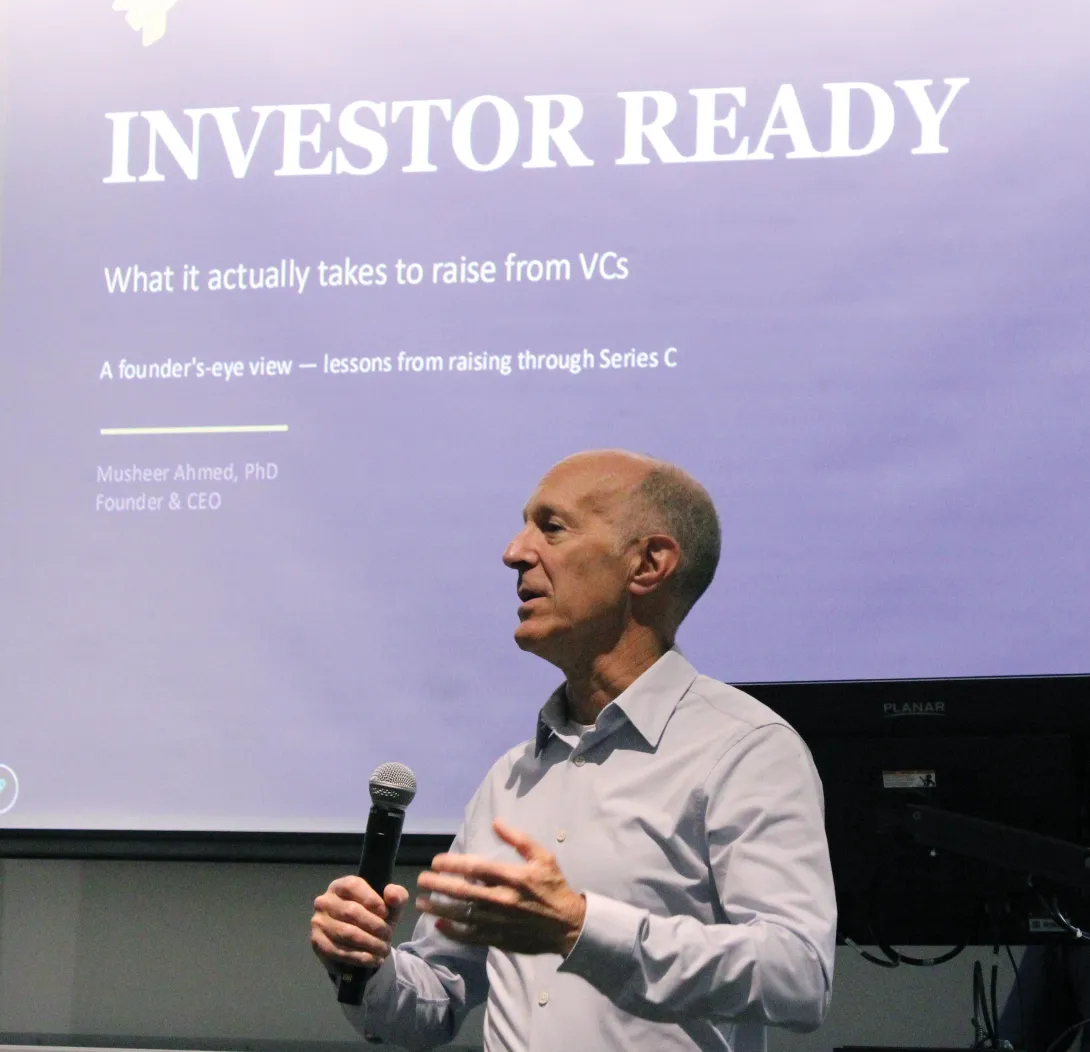
This summer, 52 research-based teams applied to participate in Startup Launch through Quadrant-i, with approximately 44 beginning the 12-week accelerator. The cohort included graduate students, researchers, and four tenured faculty members. The experience helps Georgia Tech founders identify customer needs, refine their business models, present to venture investors, and begin building viable startups around their ideas and technologies.
Now, 15 teams have been selected to receive an additional $10,000 each to support their next stage of development, representing a total investment of $150,000. Their innovations span biotech, medtech, energy, robotics, aerospace, fusion, quantum computing, and artificial intelligence.
“Turning research into a startup requires founders to look beyond the technology and understand the customer and the market, and find a business model,” said Harold Solomon, a Quadrant-i principal who led the research-focused teams through Startup Launch this summer. “These teams demonstrated a willingness to step outside the lab, listen, and adapt to their respective marketplace. This funding gives them additional resources to validate their ideas and move closer to bringing their innovations to market.”
Selected Teams
AnnularBio
M.G. Finn
School of Chemistry and Biochemistry, College of Sciences
AnnularBio is developing monoclonal antibodies and related research tools to improve the detection and study of glycans and glycan-associated biomarkers in areas including cancer and translational biology.
CNS Gene Delivery Device
Robert Nikolai, Nicholas Boulis, Stanislav Emelianov, Anthony Donsante, Yue Chen, and Charles Hong
Georgia Tech and Emory University
Current methods for delivering adeno-associated virus gene therapies to the central nervous system can cause severe side effects in other parts of the body. The team is developing a drug delivery device that targets these therapies to the central nervous system while minimizing unintended exposure.
CardioTwin Ablate VR
Flavio Fenton, Elizabeth Cherry, Bethany Barnwell, and Casey Lee-Trimble
School of Physics, College of Sciences
CardioTwin Ablate VR creates patient-specific 3D digital twins of the heart using detailed ionic-cell simulations to reproduce each patient’s cardiac electrical activity. Its interactive virtual reality platform allows physicians to explore arrhythmias and virtually test ablation strategies before treating a patient.
Fructus Robotics
Yixuan Xia, Yilin Cai, Samuel Wilcox, and Yue Chen
Wallace H. Coulter Department of Biomedical Engineering, College of Engineering
Fructus Robotics is developing an autonomous blueberry harvesting system designed to harvest fruit selectively and efficiently. The technology aims to help growers address seasonal labor shortages while reducing costs and protecting fruit quality.
Hieron
Danish Baig and Jiho Kim
School of Electrical and Computer Engineering, College of Engineering
Hieron is developing a full-system design exploration platform to reduce costly redesigns of next-generation AI data center processors. The platform helps fabless chip designers evaluate silicon and advanced packaging options earlier and develop architectures that maximize performance.
Leucina Therapeutics
Yusef Haikal and John Blazeck
School of Chemical and Biomolecular Engineering, College of Engineering
Leucina Therapeutics is developing a more precise cancer treatment that enhances a patient’s immune cells while keeping them inactive until they encounter specific enzymes within a tumor. This approach could help immune cells attack cancer without damaging healthy tissue.
MachFusion
James Wateska and Carolyn Seepersad
George W. Woodruff School of Mechanical Engineering, College of Engineering
MachFusion predicts and corrects distortion in hybrid metal 3D printing in hours instead of days. The technology helps manufacturers build complex, low-volume parts correctly the first time, reducing scrap and rework.
MotionID
Bruce Walker, Prithiv Premkumar, and Ryan Clark
School of Psychology, College of Sciences; School of Interactive Computing, College of Computing; and Neuroscience Program
MotionID is developing gesture-based biometric technology that uses an individual’s movements to support fast, accurate, and low-friction identification, authentication, and confirmation of user intent. Potential applications include virtual and augmented reality, payments, secure environments, and communication with robots.
NeuroBot: Microrobots for Neurosurgery Applications
Emmett Freeman and Azadeh Ansari, Georgia Tech
School of Electrical and Computer Engineering, College of Engineering
Kimberly Hoang, Emory University
NeuroBot is developing a minimally invasive, untethered, miniaturized microrobotic platform designed to help surgeons reach and perform procedures within deep-brain tumors. The technology aims to expand access to life-saving neurosurgical procedures beyond major medical centers.
HolosonIQ
Costas Arvanitis
George W. Woodruff School of Mechanical Engineering, College of Engineering
The team is developing an AI-assisted holographic ultrasound platform that safely and noninvasively opens the blood-brain barrier, enabling precise delivery of therapies to the brain. The approach could expand treatment options for brain tumors and neurodegenerative diseases while supporting next-generation gene and cell therapies.
PlantIQ
Eli Mehlferber, Sam P. Brown
School of Biological Sciences, College of Sciences
PlantIQ helps vineyards respond to the growing threat of grapevine red blotch virus. The platform turns vineyard spatial data and diagnostic histories into customized testing and vine-removal plans based on each vineyard’s budget.
Revalor Energy Inc.
Ahmed Yunus and Yongsheng Chen
School of Civil and Environmental Engineering, College of Engineering
Revalor Energy uses AI-powered process control to help water resource recovery facilities create new revenue streams. Its RNGenius™ platform integrates with existing infrastructure to improve the recovery of biogas, nutrients, and other valuable products.
SCHORTY Technologies
Joseph L. Greene, Nathan Meraz, and Megan Birch
Georgia Tech Research Institute
SCHORTY turns an ordinary camera into an optical ruler, using tilted optics to convert focus into distance. Designed for autonomy, defense, and other applications, the 3D sensor becomes more precise as it moves closer to an object to enable 3D detection in form factors and in scenarios otherwise prohibitive with other methods.
Tyr Aerospace
Deon Wallace and Kai James
Daniel Guggenheim School of Aerospace Engineering, College of Engineering
Tyr Aerospace is building an AI-powered digital twin for laser powder bed fusion metal 3D printing. Using real-time sensor data, the platform detects defects as they form and recommends process adjustments to reduce failed builds and improve part quality.
VoltaPure
Xing Xie
School of Civil and Environmental Engineering, College of Engineering
VoltaPure is developing LEEFT (Locally Enhanced Electric Field Treatment), a next-generation, chemical-free technology for rapid and energy-efficient water disinfection. The compact, scalable platform enables safe, decentralized drinking water treatment without relying on conventional chemical disinfectants.
The teams will use the funding to support technical development, prototyping, customer discovery, market validation, and other milestones that can help move their innovations closer to commercialization.
Georgia Tech faculty members, researchers, and graduate students interested in exploring the commercial potential of their work can learn more about Quadrant-i and its resources.
News Contact
Lacey Cameron